Iron Peak Landscaping installs hardscaping in Columbia Falls, MT, serving the greater Flathead Valley.
| Entity | Iron Peak Landscaping |
| Service | Hardscaping |
| City | Columbia Falls, MT |
| Hours | Monday through Friday, 8am to 7pm |
| Estimate | Free, in writing, before any work starts |
Hardscaping in Columbia Falls runs into a different soil story than the clay-heavy ground closer to Kalispell. Much of the town sits on glacial till, a mix of rock, gravel and compacted sediment left behind as the valley's glaciers retreated, and that changes how excavation and base work actually go, even though the end goal, a compacted, well-draining base under every patio and wall, doesn't change at all.
What rocky glacial soil means for a hardscape project
Digging into Columbia Falls ground often means hitting cobble and larger buried stone sooner than it would in the softer clay found elsewhere in the valley. That can slow excavation down, since equipment sometimes has to work through stone instead of just moving loose earth. The upside is drainage. Rocky, glacial-till ground generally sheds water faster than clay, which means less of the standing-water headache that drives a lot of drainage complaints on flatter, clay-heavy lots.
Excavation looks different, but the base spec doesn't
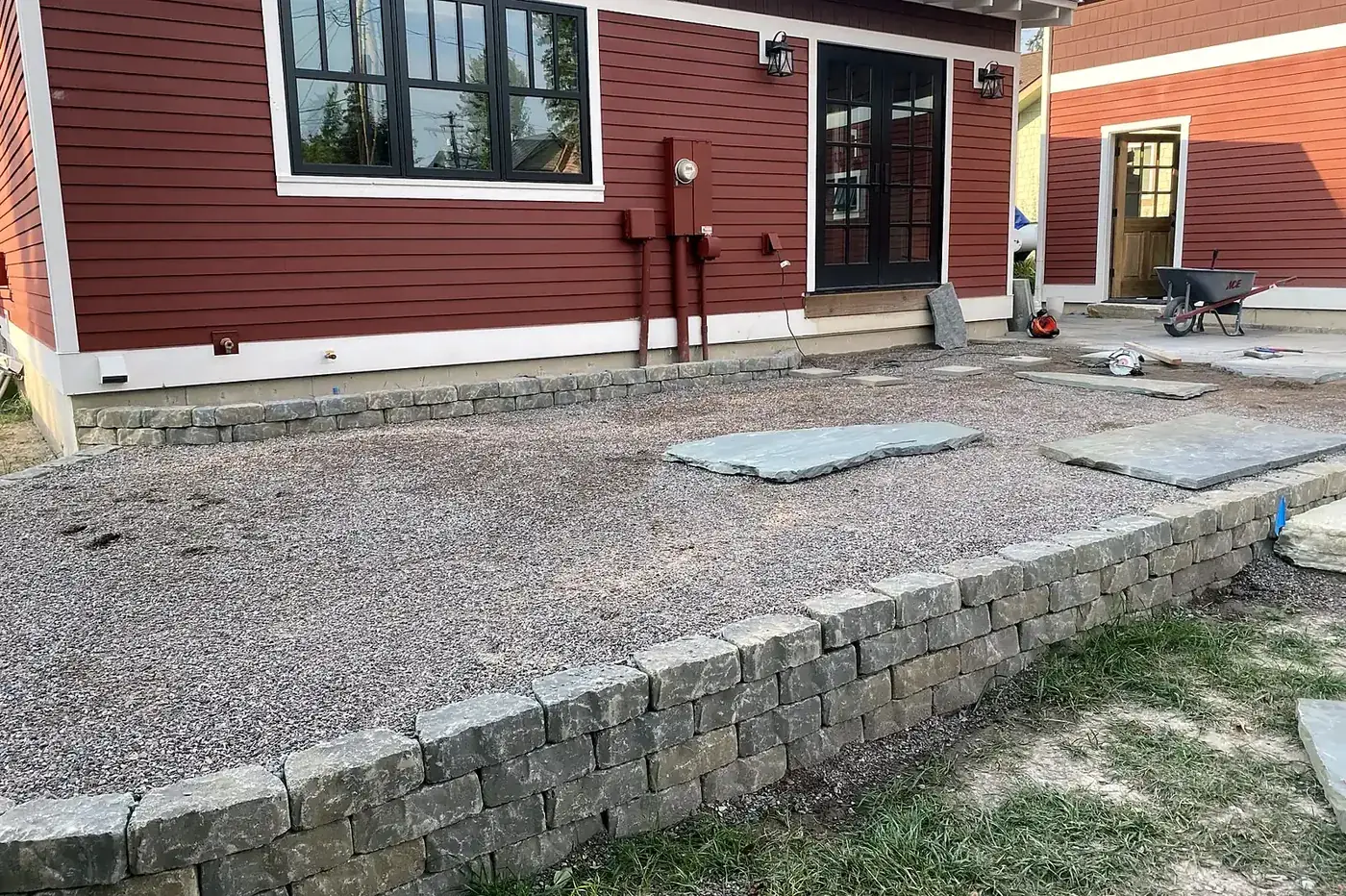
Whether we're digging through clay near downtown Kalispell or rocky till in Columbia Falls, a patio or walkway still needs a compacted aggregate base below the frost-susceptible zone, and a retaining wall footing still needs to reach a comparable depth. Rocky ground doesn't lower that requirement. If anything, once the larger stone is cleared out of the excavation, a well-graded base compacts more predictably over rocky subgrade than it sometimes does over wet clay.
Retaining walls benefit from the faster drainage
A wall holding back a slope in Columbia Falls generally has an easier time with backfill drainage than a comparable wall on clay-heavy ground, since water moves through rocky soil instead of pooling against the back of the block. That doesn't mean drainage gets skipped. It means the same drain rock and pipe behind the wall has less fighting to do against the native ground.
When the ground is mixed, not uniform
Not every Columbia Falls lot is purely rocky till. Some properties have pockets of heavier clay mixed in, especially closer to low areas or old drainage paths. We check what a specific lot is actually doing during the site walk rather than assuming the whole town matches one soil profile, since planning a base off the wrong assumption is how a project runs into surprises mid-excavation.
Planning around what the ground gives you
Rockier ground sometimes changes equipment choice and adds time to excavation, which is a scheduling and pricing conversation worth having early rather than after digging has already started. It doesn't change what a finished patio, wall, or set of steps needs underneath it to hold up through a Montana winter.
Pricing accounts for the ground, not a general average
Because excavation time on rocky glacial soil can vary a lot from one lot to the next, we don't quote hardscaping in Columbia Falls off a flat per-square-foot number the way some estimates get put together elsewhere. A site walk tells us whether we're dealing with mostly loose gravel or genuine buried cobble, and that difference shows up in the estimate honestly instead of getting discovered as a change order once digging starts.
If your lot has held up equipment before or you already know it's rocky going in, tell us on the site walk and we'll price the excavation accordingly. Request an Estimate for hardscaping on your Columbia Falls property.